

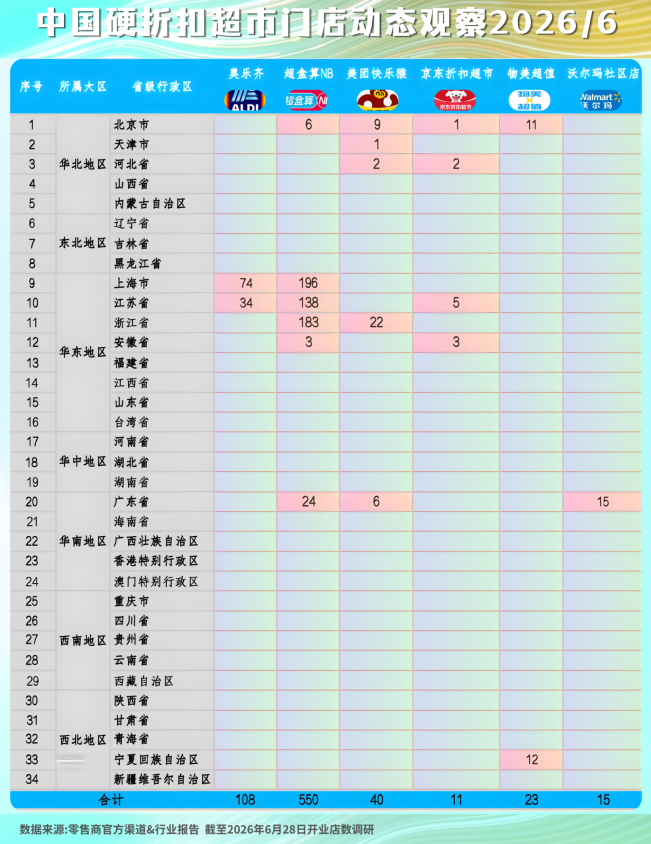
Discount Retail Chain ALDI China, 7 years after introducing hard discount to mainland China in June 2019, faces a fundamental strategic question: Has the original German “teacher” of hard discount been surpassed by local digital-first competitors like Freshippo Ultra NB (盒马超盒算NB)?
While fast-scaling local players have surged ahead in door counts and regional coverage, ALDI’s core moat — uncompromising cost discipline, private label dominance, and high-yielding single-store economics — remains unassailed.
1. ALDI’s Market Position: Quality Growth Over Rapid Expansion
China’s hard-discount market has stratified into six primary formats (German-native ALDI, tech-backed Freshippo Ultra NB, Meituan’s Kuailaihou, Walmart’s community stores, Wumei’s Value stores, and JD’s discount stores).
Despite broader retail headwinds, ALDI China has maintained impressive momentum by adhering to a “logistics-first, store-second” expansion formula:
Revenue Trajectory (CCFA Data): Scaled from ¥750 million (€95M) in 2022 to ¥4.0 billion (€510M) in 2025—a fivefold increase in three years, doubling year-over-year in both 2024 and 2025.
Top 100 Ranking Surge: Climbed 57 spots in the CCFA Top 100 Supermarket rankings (from 92nd in 2022 to 35th in 2025).
Controlled Regional Footprint: Kept all new store additions strictly within a 200 km supply-chain radius in East China, expanding methodically along the G42 Shanghai-Chengdu highway belt (Shanghai → Suzhou/Wuxi → Nanjing → secondary cities).
2. The Uncopyable Moat: Embedded Cost Discipline
While local copycats replicate ALDI’s shelf layouts, self-checkout, and simplified SKUs, they struggle to replicate the organizational “cost-consciousness” built into ALDI’s DNA:
Private Label Mastery: Private label represents over 90% of ALDI’s SKU mix across 14 master brands. By stripping out middleman markups and brand premiums, shelf prices run 15%–30% lower than national brand equivalents.
Top-Tier Store Productivity: ALDI’s Shanghai locations achieve single-store annual revenues exceeding ¥36 million (€4.6M), maintaining industry-leading sales-per-square-meter (坪效) and steady profitability across 88 locations (end of 2025).
3. The 3 Local Friction Points for German Hard Discount
Despite its operational efficiency, ALDI’s pure German model faces three structural friction points in China’s unique retail environment:
ALDI CHINA: THREE STRATEGIC DILEMMAS
1. Scale vs. Efficiency
108 stores (ALDI) vs. 550+ (Freshippo NB) Paradox
Slow growth risks closing Northern/Southern China market windows.
2. Fresh Food Bottleneck
Fresh = 35% mix, 100% pre-packed (ALDI)
Local demand prefers higher fresh mix (Freshippo NB = 60%+ fresh mix)
3. Direct-Operated (COCO)
Long decision chains vs. flexible local rigidity franchise (FOFO) expansion models.
The Scale vs. Efficiency Paradox: With only ~108 stores by mid-2026 compared to Freshippo Ultra NB’s 550+ stores (which utilizes a hybrid direct / franchise model), ALDI’s deliberateness limits its raw purchasing power scale.
Fresh Food Preferences: In Germany, fresh food is secondary; in China, it drives foot traffic. ALDI caps fresh items at ~35% (all pre-packaged) to control shrinkage, whereas local competitors run 60%+ fresh mixes to capture daily home-cooking demand.
Capital-Intensive Direct Ownership (COCO): ALDI bears 100% of store buildout and real estate risk. Local competitors leverage regional franchisees to absorb capital costs in lower-tier markets.
Key Strategic Takeaway
If scale is defined purely by store count and geographic footprint, digital-native local players like Freshippo Ultra NB have indeed pulled ahead.
However, if hard discount is defined by underlying efficiency, private-label margin control, and store-level profitability, ALDI’s foundational model remains undefeated. Hard discount is a marathon, not a sprint — and ALDI’s restraint reflects a commitment to long-term profitability over short-term store counts.
1. ALDI’s Market Position: Quality Growth Over Rapid Expansion
2. The Uncopyable Moat: Embedded Cost Discipline
3. The 3 Local Friction Points for German Hard Discount
ALDI CHINA: THREE STRATEGIC DILEMMAS
1. Scale vs. Efficiency
2. Fresh Food Bottleneck
3. Direct-Operated (C